












L’huile d’argan – Argan oil
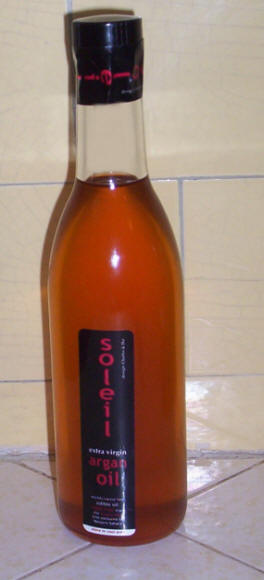
Argan oil
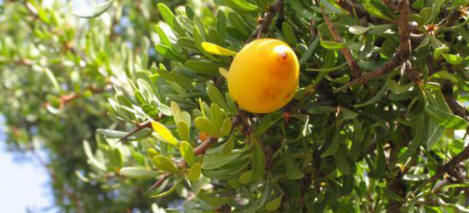
Plantation of argans
Argan Oil is rich in essential
fatty acids and is more resistant to
oxidation than
olive oil.
Argan oil is used for dipping bread, on
couscous,
salads and similar uses. A dip for bread known as
amlou is made from argan oil,
almonds and
peanuts, sometimes sweetened by
honey
or sugar. The unroasted oil is traditionally used as a treatment
for skin diseases, and has found favour with
European
cosmetics manufacturers.
Argan oil is an
oil produced from the fruits of the
Argan
(Argania
spinosa) a species of
tree
endemic to the
calcareous
semi-desert of southwestern
Morocco. It is the sole species in the genus
Argania. The Argan tree now grows only in SW
Morocco. It is believed to date back 25,000,000 years and to
have once covered N. Africa. Now endangered and under protection
of
UNESCO,[1]
the Argan grows wild in semi-desert soil, its deep root system
helping to protect against soil erosion and the northern advance
of the Sahara.[2]
It was first reported by the
explorer
Leo Africanus in 1510. An early
specimen was taken to
Amsterdam and then cultivated by
Lady Beaufort at
Badminton c1711. Now only 8600 square kilometres remain in
S.W. Morocco and these are declining at a rate of 500 km² per
year.
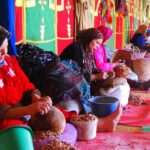
The most labour intensive part of oil-extraction is removal
of the soft pulp (used as
animal feed) and the cracking by hand, between two stones,
of the hard nut. The seeds are then removed and gently roasted.
This roasting accounts for part of the oil’s distinctive, nutty
flavour. The traditional technique for oil extraction is to
grind the roasted seeds to paste, with a little water, in a
stone rotary
quern. The paste is then squeezed between hands to extract
the oil. The extracted paste is still oil-rich and is used as
animal feed. Oil produced by this method will keep 3-6 months,
and will be produced as needed in a family, from a store of the
kernels, which will keep for 20 years unopened. Dry-pressing is
now increasingly important for oil produced for sale, as the oil
will keep 12-18 months and extraction is much faster.
Goats like the pulp of argan fruits and often try to climb
the trees to get at them. They will digest the pulp, but shed
the undigested seeds in their
feces.[2]
As these have shells that are somewhat softened and easier to
crack, they are occasionally used to produce oil for
non-culinary purposes. An
urban legend has it that all argan oil is produced this way.
This myth seems to be based on the fact that occasionally,
shrewd traders would have sold (and may still try to sell) such
« non-food grade » argan oil to ignorant travellers or tourists.
The fact that the nuts acquire a foul aroma in passing through
the animal’s digestive tract makes it easy to tell this oil
apart from food-grade produce with its rich,
walnut oil-like flavor (Nouaim 2005).
The oil contains 80%
unsaturated
fatty acids:[3]
Huile d’argan
Un article de Wikipédia,
l’encyclopédie libre.
L’huile d’argan (ou d’argane) est tirée de l’arganier,
arbre endémique du
Maroc,
présent essentiellement au sud-ouest du pays entre
Agadir,
Essaouira et
Taroudant. Elle est très utilisée dans la cuisine
traditionnelle de cette région.
Cette huile, riche en
vitamine E et
insaponifiable, est également reconnue pour ses propriétés
nourrissante, régénérante et restructurante.
Spécificités
Il existe deux types d’huile d’argan selon que les amandons
sont ou non torréfiés avant utilisation. L’huile alimentaire,
plus sombre et au goût plus prononcé à cause de la torréfaction,
s’utilise comme une huile habituelle pour préparer les aliments.
Elle est très nutritive et constitue, avec des amandes pilées et
du miel, l’amlou,
une pâte très nourrissante souvent consommée au petit déjeuner.
L’huile cosmétique, plus claire, s’utilise en application sur la
peau et les cheveux et aurait des vertus contre la chute des
cheveux, l’eczéma,
la déshydratation cutanée… La chercheuse Zoubida Charrouf,
spécialisée en
chimie organique à l’université de Rabat, a beaucoup
contribué à la connaissance scientifique de cette huile et des
autres sous-produits de l’arganier. Grâce au CRDI (Centre
de recherches pour le développement international, société
d’État
canadienne), elle a aussi œuvré à l’établissement des toutes
premières coopératives de traitement de l’huile d’argan,
entièrement dirigées par des femmes.
L’huile d’argan est utilisée dans l’alimentation car son goût
d’amande et de noisette (dû à une légère torréfaction qui lui
donne aussi sa couleur plus foncée) rehausse la saveur des
plats, comme le
couscous, les poissons et les vinaigrettes.
D’après des publications scientifiques, elle permet :
- La stabilité de l’hypercholestérolémie[3],[4]
- Stimule les cellules cérébrales et le fonctionnement du
foie.[réf. nécessaire] - Protège le tissu conjonctif.[réf. nécessaire]
C’est l’une des huiles alimentaires les plus chères du monde